This website summarizes my Research Projects and lists my Publications in Human-Computer Interaction.
I received my PhD in computer science from the Media Computing Group and worked as postdoctoral researcher at the in|situ| lab, the BIG group and the INTERACT lab.
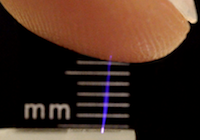
Sparkle stimulates the fingertip with touchable electric arcs above a hover sensing input device. We use a high voltage resonant transformer and a self-resonating circuit for which we control the electric discharge to create in-air tactile and thermal sensations up to 6 mm in height, and combine this technology with infrared proximity sensing. Sparkle is the first step towards providing a new type of in-air feedback for hover input without requiring users to wear tactile stimulators.
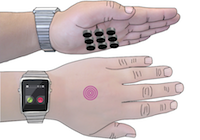
SkinHaptics is a novel technology that can help to expand the output capability of on-body interfaces to provide tactile feedback without restricting the skin as an interaction surface. SkinHaptics works by focusing ultrasound in the hand using a phased array of ultrasound transmitters and the acoustic time-reversal signal processing technique. The transmitters are located at one side of the hand. The other side remains free for interaction. With our proof-of-concept prototype we have demonstrated that low-intensity ultrasound can create sensations that are perceived under the skin and in the hand.
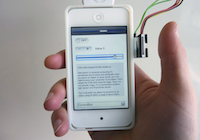
The Power-up Button is a physical button that combines pressure and proximity sensing. One infrared proximity sensor is superimposed on one continuous pressure sensor and attached to the side of a mobile device adjacent to the thumb. This setup allows sensing both the distance to the user's thumb and the continuous pressure that the user applies to the casing. Six gestures that are performed with the thumb on and around the button provide users with bi-directional navigation capabilities and with full one-handed control of interface widgets without using touch input.
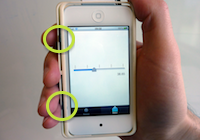
SidePress augments mobile devices with two continuous pressure sensors co-located on one of their sides. These sensors provide users with generic bidirectional navigation capabilities at different levels of granularity. SidePress is an alternative to traditional navigation techniques such as scrollbars, drag-and-flick, or pinch-to-zoom.
Tactile Motion Instructions are artificial vibrotactile stimuli that signal how move the body. These tactile instructions can be applied in real-time during physical activities, for example to help snowboarders correct wrong posture. With our custom-built Wearable Assistant for Snowboard Training we have evaluated tactile motion instructions with amateur snowboarders during a snowboarding course on the slope.
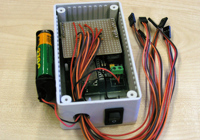
The Toolkit for Prototyping Wearable Computing Applications consists of a custom-built sensor and actuator box, a mobile phone with Bluetooth technology, and custom software for data analysis and visualization. This toolkit allows experimenting with various sensors and actuators in the field, and fosters building and testing interactive systems that respond to simple body movements, such as our custom-built Wearable Assistant for Snowboard Training.
Voice conversion transforms a person's utterance into the voice of another and can create the illusion that you can speak foreign languages. Minnesang: Speak Medieval German was the first Wizard-of-Oz study that explored voice-conversion for an interactive museum exhibit.